
Precision Bending Tester for Flexible Electronics
Automated 0–180° bend cycling and stable electrical contacting for validation

About the cooperation
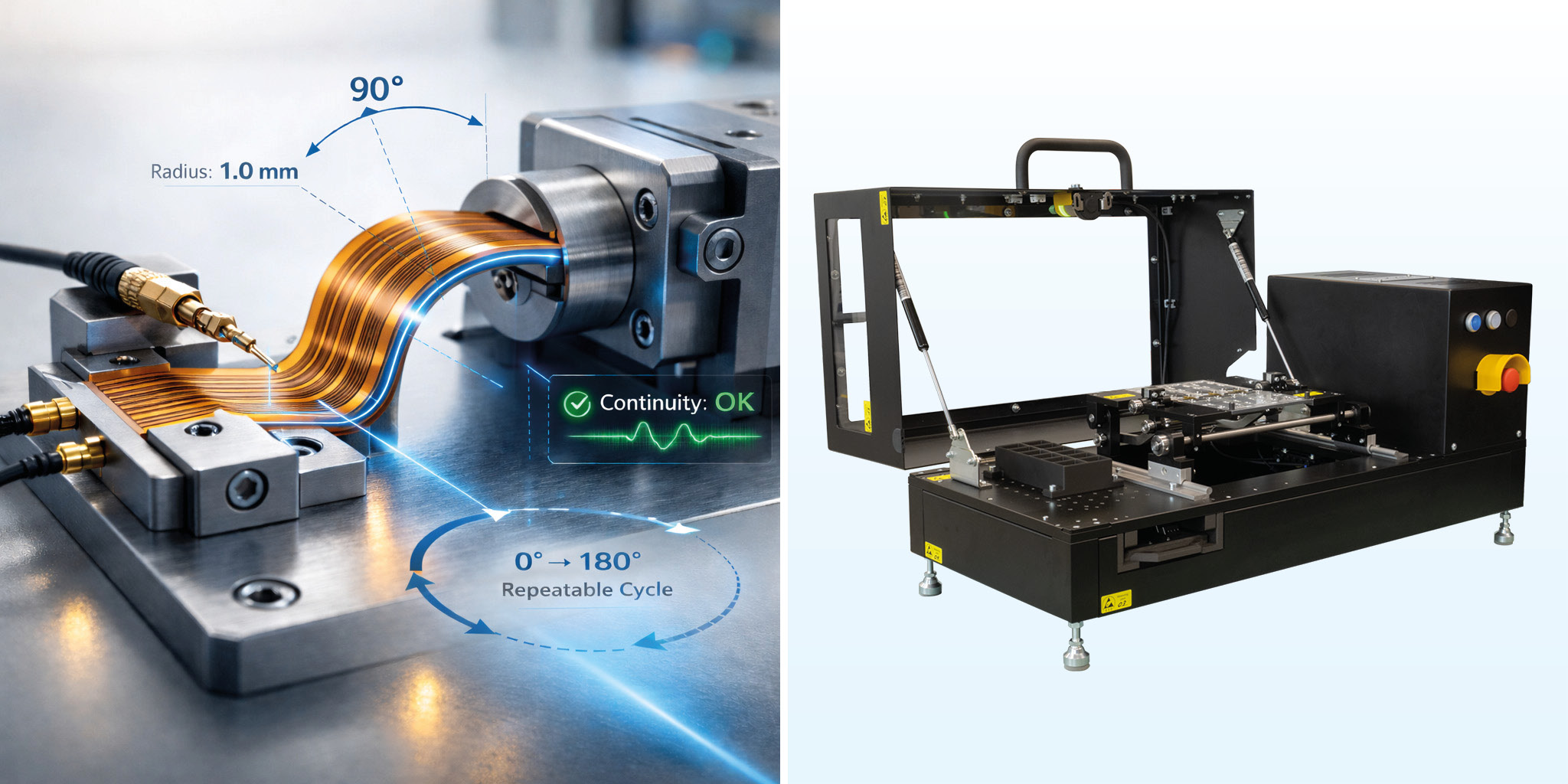
The project involved the design and construction of a compact bending test machine for performing repeatable mechanical cycles on flexible electronic parts. The system enables defined bending radii and angle sequences while maintaining electrical contact for continuity/stability tests during movement.
The fast and pragmatic development of customer-specific automation and test equipment, in-depth mechanical/mechatronic expertise, close collaboration and a structured verification approach through FAT qualified Konrad Technologies as the partner of choice.

Project Scope
Challenges
- A need for a repeatable, verifiable bending test for sensitive flexible electronics, including reliable electrical contact during dynamic motion to validate performance under mechanical stress.
- Specific requirements:
- Adjustable bend radius 0.5–5.0 mm (nominal range)
- Bend angle range 0–180° with defined target angles (e.g., 0/45/90/180°)
- Uniform circular arc (no flattening or asymmetry)
- Electrical contact stability during bending (no interruption)
- Repeatability of flap motion (position/angle)
- Host communication and triggers (Start/Stop, Flat/Bent position, dynamic movement)
- Safety: E-stop and interlocks, 230 VAC supply validation, ESD/grounding concept
- Quick set-up/clamping time for dummy/DUT
Objectives:
- Deliver a validated bending test system that supports multiple bend radii and programmable angle profiles/cycles to standardise test campaigns and generate comparable results across designs.

Solution
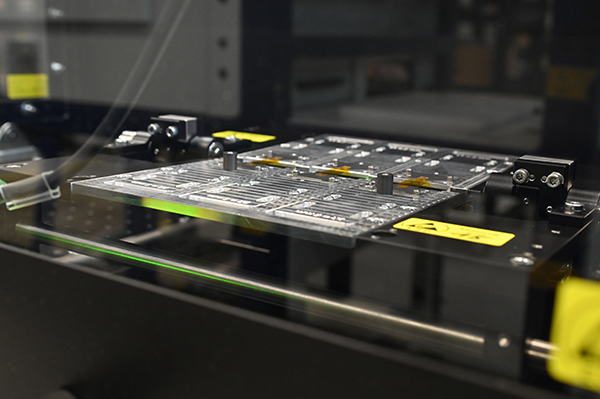
Konrad Technologies implemented a compact, enclosed bending test machine with transparent guarding and integrated controls, designed to clamp, contact, and bend flexible parts in defined cycles with repeatable geometry settings.
Functions:
- Secure clamping across DUT size range
- Bend radius set-up and verification (mechanical stops + arc measurement)
- Angle control 0–180° and repeatable cycling (e.g., 0–90° process or customer profiles)
- Electrical contacting during motion (continuity / signal stability monitoring)
- Host communication, triggers and status signals (Start/Stop, Flat/Bent, etc.)
- Safety features (E-stop, interlocks) and ESD/ground path verification
Technologies/processes:
- Mechanical radius/angle architecture with defined stops
- Repeatable flap mechanism
- Safety enclosure/interlocks
- PC/controller interface for commands, triggers and test execution
Applied test procedures:
FAT verification against a structured requirement list:
- Radius and angle measurement
- Repeatability over multiple cycles
- Visual arc-shape inspection
- Continuity test during motion
- Communication/trigger validation
- Safety/interlock testing
- ESD/ground resistance check
- 230 VAC supply verification
- Operation checks within specified temperature/humidity window
Challenges during implementation and solution:
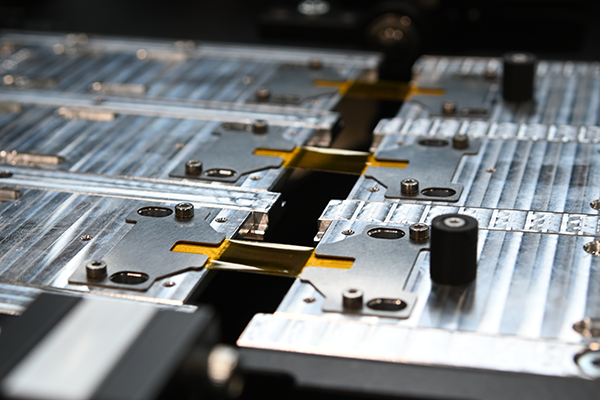
At very small radii (e.g., 0.5 mm RoC) the sample can show an undesired inward kink/reverse bend tendency depending on loading conditions. This was mitigated by introducing a pre-centring/pre-angling step during loading that gently guides the sample into the intended bend direction (without over-pressing). After loading, the system returns to the standard sequence: flaps close to a coplanar/parallel position, contacting is closed, and then the normal bending cycles run.

Customer Benefit
From this solution the customer gained a validated, repeatable bending test platform enabling standardised evaluation of flexible electronic parts with configurable radii/angles and stable electrical contacting — supporting faster development iterations and consistent data.
Measurable improvement:
- Repeatable and verifiable test conditions (radius/angle/cycle definition)
- Reduced test variability through defined loading/clamping strategy
- Structured FAT acceptance as a foundation for internal approvals and future test campaigns

Our know-how for project implementation
Strengths that contributed most to the success of this project:
- Rapid, customer-specific mechanical/mechatronic development
- Structured FAT execution with measurable acceptance criteria
- Close, iterative collaboration (PoC-oriented engineering)
- Focus on usability, safety, and test repeatability
Key insights and best practices gained from this project:
- For smallest radii, controlled guidance during the loading phase is crucial to avoid reverse kinks.
- Contacting needs tolerance-robust design for dynamic motion (stack-up, spring travel, strain relief).
- Early alignment on measurable acceptance criteria accelerates FAT and reduces ambiguity.
Request Case Study as PDF
Download the case study as a PDF for easy offline access to valuable insights that you can refer to whenever you need them!
your project!
Let us know what you're working on and how we can help you get there through our long term experience in large high tech projects.
Get in touch